
Stop Guessing: A Simple Framework for Measuring Micro-Influencer Campaigns Beyond Vanity Metrics
Here’s a conversation that happens in marketing teams every quarter:
“How did the influencer campaign do?” “Really well. We got 4,200 likes and the reel hit 80,000 views.” “Great. What did it cost us?” “$3,500 across four creators.” “And what did we sell?” “…we’re not sure.”
If that sounds familiar, you’re not alone. Most brands running micro-influencer campaigns can tell you exactly how many people tapped the heart button. Very few can tell you how many of those people bought something.
This post is about fixing that, without a six-figure analytics stack.
Why Vanity Metrics Became the Default
Measuring influencer impact is genuinely hard. The path from “I saw a creator talk about this product” to “I bought it three weeks later” doesn’t leave a clean data trail. So marketers defaulted to the metrics that were easy to pull: reach, impressions, likes, saves, comments.
Those numbers aren’t useless. They tell you something about attention. But attention and revenue are not the same thing.
The good news is that micro-influencer campaigns, specifically, are more measurable than most people think. Because the audience sizes are smaller and more targeted, the signals are cleaner. You just have to set the measurement up before the campaign launches, not after.
The Three Metrics That Actually Matter
Before you brief a single creator, align your team on three numbers:
- Attributed conversion rate What percentage of people who clicked through from the creator’s content actually converted (signed up, purchased, registered)? Set a UTM parameter or unique link for each creator so you can track this per person.
- Cost per acquisition (CPA) from influencer traffic Take the creator’s fee and divide it by the number of conversions they drove. Compare this to your other acquisition channels. Is influencer traffic cheaper or more expensive than paid social? The answer might surprise you.
- 30-day retention of influencer-acquired customers This one is underused. Customers who discover you through a trusted creator often stick around longer than those from a paid ad. Track cohort retention for influencer traffic for 30 days. If it’s higher than your baseline, that’s a meaningful argument for increasing the influencer budget.
The Tracking Setup (No Fancy Tools Required)
You need four things:
- Unique UTM links for each creator. Build them in Google’s UTM builder. Free, takes two minutes per creator.
- A unique discount or promo code per creator. Even if you don’t run discounts normally, a code like SARAH10 or MIKE15 gives you clean attribution data that doesn’t require UTM tracking to survive.
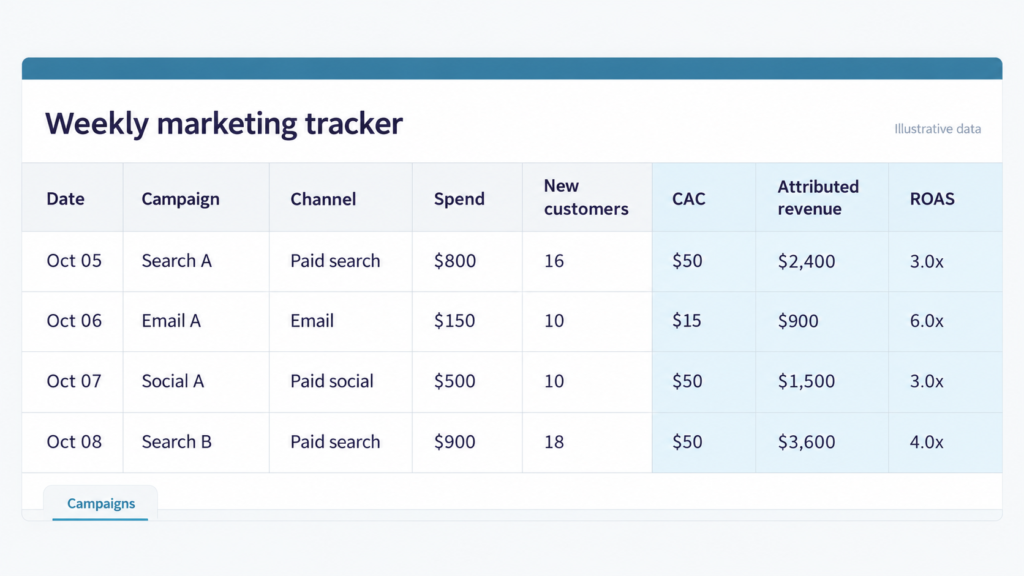
- A simple Google Sheet that tracks each creator by name, fee, platform, content URL, clicks, conversions, and CPA. Update it weekly during the campaign.
- A 7-day and 30-day check-in. Most campaigns get measured once, at the end. Check in at 7 days to see if anything needs to be adjusted while the campaign is still live.
That’s it. You don’t need a platform subscription or a data analyst. You need discipline around setup.
How to Benchmark What "Good" Looks Like
Micro-influencers (typically 10,000 to 100,000 followers) average about 3% engagement on sponsored content, compared with 1.3% for accounts over 500,000 followers. But engagement rate alone doesn’t tell you much about your specific campaign.
Set your benchmarks before the campaign using these questions:
- What’s our current blended CPA across paid channels?
- What’s our average order value (AOV) or lifetime value (LTV)?
- At what CPA does influencer spend become profitable given our margins?
If your current paid social CPA is $42 and a micro-influencer drives conversions at $38, that creator is outperforming your paid channels, even if their reel only got 600 likes.
What to Do With the Data
After a campaign ends, you should be able to answer five questions:
- Which creator drove the most conversions?
- Which creator had the lowest CPA?
- Which creator’s audience retained at the highest rate after 30 days?
- What content format performed best (short video, static post, story)?
- What would it cost to scale the top performer?
Take those answers into your next campaign brief. Give your best-performing creator a second campaign with a larger budget. Cut the bottom performers. Adjust the content format based on what worked.
Most brands run one influencer campaign, measure it poorly, and then argue about whether influencer marketing “works.” The ones building real programs treat each campaign as a test and use the data to run a better test next time.
The Bottom Line
Micro-influencer marketing can be one of the most cost-effective acquisition channels you have. But only if you measure it correctly. Set up the tracking before the campaign launches. Track the three metrics that matter. Build a simple system, and actually use the data.
The brands winning at this aren’t the ones with the biggest influencer budgets. They’re the ones who treat campaigns like experiments instead of press releases.